










This project receives funding from the European Union’s Horizon 2020 research and innovation programme under grant agreement No. 862480.
email@email.com
Cookies policy · Privacy policy
© 2025 Living Fields | All Rights Reserved | Powered by Scienseed
This project receives funding from the European Union’s Horizon 2020 research and innovation programme under grant agreement No. 862480.
email@email.com
Cookies policy · Privacy policy
© 2025 Living Fields | All Rights Reserved | Powered by Scienseed
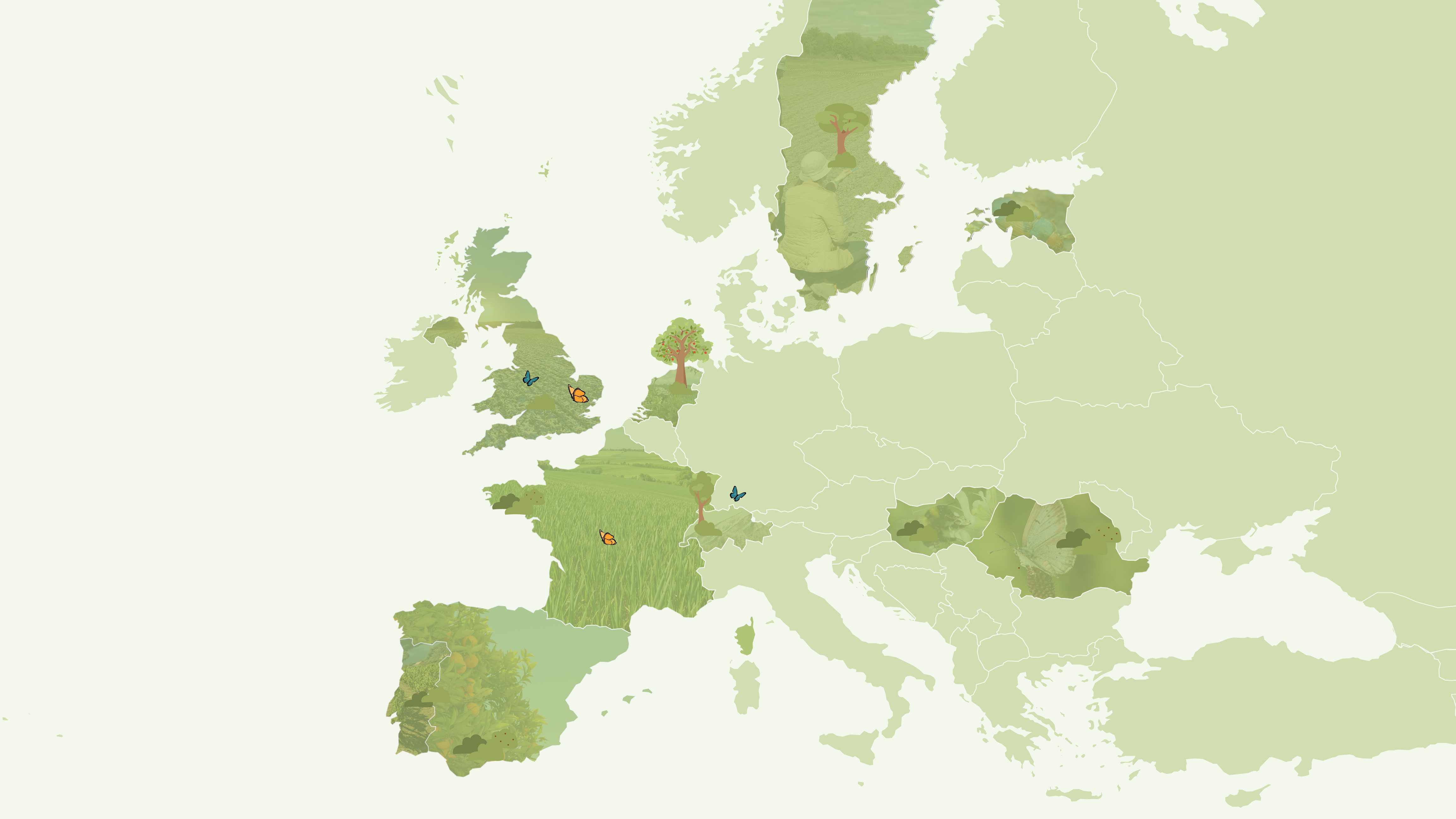
The Romanian EBA
Transylvania
In Romanian grasslands, butterfly diversity increased after shrub removal, but results show that maintaining at least 10% shrub cover is essential to sustain biodiversity, and to keep farmers eligible for financial support under shrub management schemes.
The Hungarian EBA
Kiskunság región in Central Hungary
In Hungarian farms, wildflower patches were introduced on fallows and field edges to support pollinators and improve biodiversity, without reducing yields. Both interventions had positive effects on biodiversity and ecosystem services.
Mainland Estonia’s western and southwestern coast
In Estonia's coastal grasslands, researchers compared grazed and abandoned areas to understand their impact on soil-dwelling arthropods. The findings underscore the need for balanced management strategies that combine grazing with habitat conservation to sustain diverse and resilient ecosystems.
Southern Sweden
From hosting conservation work to getting involved in species monitoring, different forms of volunteering help farmers support biodiversity in Sweden. These collaborations build connections between farmers, researchers, and nature enthusiasts, while contributing valuable data for conservation.
The Swiss EBA
In Swiss cereal farms, wildflower strips, reduced pesticide use, and mechanical weeding were tested as agroecological alternatives. Results showed that, while these practices clearly benefit biodiversity, they present challenges in maintaining competitive crop yields, emphasising the need for targeted farmer support.
The Dutch EBA
South-East of the Netherlands
In Dutch grasslands, researchers analysed how more extensive management affects biodiversity and farmer income, revealing that financial incentives —such as price premiums, public payment schemes or taxation of negative impacts— are key to make biodiversity-friendly farming viable.
The British EBA
Aross Southern England
In UK arable fields, farmer-led research showed that winter cover crops improved soil biodiversity and health, increasing earthworm and spider populations. Overall, our findings show that cover crops can deliver multiple environmental benefits after just one season, with likely greater gains over time.
The French EBA
Nouvelle Aquitaine Region
In French cereal farms, researchers worked with conventional and organic farmers to reduce inputs like pesticides and tillage, measuring the effects on biodiversity, yields and farm income. This EBA led to practical evidence that biodiversity and productivity can go hand in hand across various systems.
The Spanish EBA
Sevilla
In Spanish stone fruit orchards, farmers trialled flower covers between tree rows to boost pollinators without reducing fruit yields. In addition, green covers can help reduce the need for herbicides, lower production costs and further reduce environmental impact
The Portuguese EBA
Alentejo
In Portuguese olive groves, sowing inter-row vegetation proved effective in helping biodiversity conservation in olive farms, even under intensive management. Specifically, the increased diversity and biomass of plants in the experimental treatment led to a higher richness and abundance of bees, spiders and plants.
